


In recent years, the commercialization of the American health care industry has challenged medicine across the breadth of its traditional roles and responsibilities. This trend is growing, and the greater emphasis on the commercialization and secularization of medicine has generated in medical professionals a passionate desire to reconnect with the core values, practices, and behaviors that they see as exemplifying the very best of what medicine should be about.
The American College of Surgeons and ACS Surgery: Principles and Practice, its comprehensive clinical reference for practicing general surgeons, support surgeons in their efforts to renew their pledge to the core values of professionalism. Although market-place realities cannot be dismissed, we believe, like you, the practicing surgeon, that the doctor-patient relationship is the foundation on which world-class surgical care is provided. Surgeons have long been committed to working unforgiving hours while frequently squeezing in extra patients, not to mention professional education, family life, and personal interests. Of late, however, the marketplace pressures to scrimp on the time we spend with our patients have increased hugely.
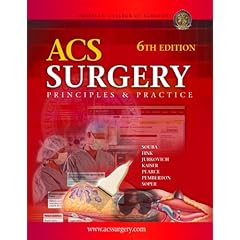
The chapters in ACS Surgery are designed to support your commitment to compassionate patient care by providing the information you need to continually refine your skills and to perform key procedures more efficiently and with better outcomes. Just some of the new features in your 2005 edition of ACS Surgery include a brand-new section on head and neck problems and procedures, as well as a greatly expanded alimentary tract section with, for example, coverage of Crohn disease and the operative management of rectal cancer.
The surgeon-patient relationship should be regarded as a covenant governed by trust and commitment rather than as a commercial transaction governed by the marketplace or a contract. Surgeons enjoy a privilege unique to our discipline: our patients 'give us permission'to perform complex and complicated operations on them to restore health and well-being.
Wiley W. Souba M.D., Sc.D., F.A.C.S.
FOREWORD
ACS Surgery: Principles and Practice 'offered in three formats: a Web site at http://www.acssurgery.com, a CD-ROM, and a classical hardbound volume' is designed to address the needs of the professional surgeon in 2005. Several aspects of this reference are worthy of special comment; and two are especially important, given the changes announced by the American Board of Surgery that concern all surgeons seeking recertification in the near future.
First, ACS Surgery has added several sections that are normally not seen in surgical texts but that address contemporary concerns and issues relevant to the six Competencies of the Accreditation Council for Graduate Medical Education and American Board of Medical Specialties' key criteria against which surgeons seeking recertification soon will be judged. A systems approach to patient safety is the subject of one chapter; another deals with risk stratification in preoperative testing; and a third, with the avoidance of malpractice claims and the importance of good communication skills in maintaining patient satisfaction.
Second, ACS Surgery covers the established areas of general surgery well but has added many chapters that address subjects highly relevant in 2005. Chapters on the surgery of morbid obesity, colon resection, and hernia repair are all well done. The extensive coverage of trauma and critical care, which was representative of the earlier editions, is maintained here in two independent sections. The coverage of several basic considerations for the beginning surgeon in regard to anesthesia, infection, bleeding, pain management, and postoperative care will make this valuable for residents. Sections devoted to geriatric, pediatric, and pregnant patients are valuable for surgeons of all levels. And, as is essential for such a visual discipline as surgery, the illustrations are well-rendered and presented in color.
Third, the selection of authors for the various chapters is extraordinarily well done, and there is an excellent balance of experienced senior surgeons with younger ones who have specific operative expertise in newer areas. The authors selected are generally recognized to be among the most knowledgeable and experienced in the areas being written about, with the result that the information provided is based on extensive personal experience and is completely current.
One of the many features particularly relevant to surgeons who seek recertification in surgery from the ABS is the optional interactive and integrated Online CME program with ACS Surgery Online (http://www.acssurgery.com). Surgeons can earn up to 60 Category 1 CME credits per year through the completion of case-based self-assessment questions based on chapters in ACS Surgery. The initiation of Maintenance of Certification by the ABS in 2005 will require completion of 50 credits of yearly self-assessment examinations, and this option will fulfill the requirement easily.
In summary, this is an excellent new edition of a well-accepted general surgical text that will be of value to residents and practicing general surgeons alike.
Frank R. Lewis Jr. M.D., F.A.C.S.
Book Details
- Hardcover: 1984 pages
- Publisher: WebMD Professional Publishing; 6th edition (June 22, 2007)
- Language: English
- ISBN-10: 0977222624
- ISBN-13: 9780977222629
- Product Dimensions: 11.2 x 8.8 x 2.4 inches